What Happens When Every Child Has a Personal AI Tutor?

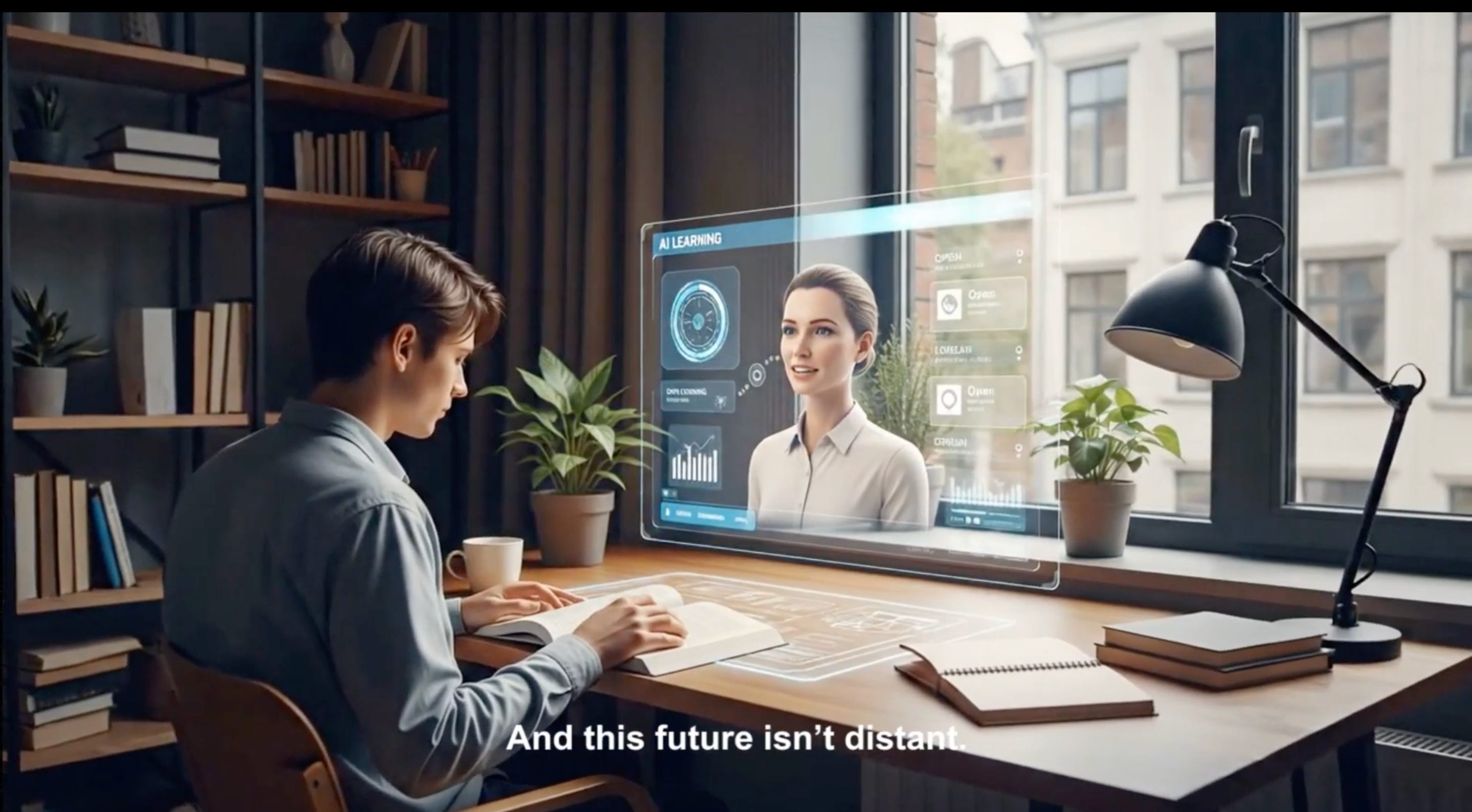
The evidence suggests learning may be algorithmic.
The danger is mistaking efficiency for understanding.
For decades, the idea of a personal tutor for every child belonged to the realm of fantasy.
Too expensive. Too scarce. Too human.
Now, for the first time in history, that constraint has collapsed.
The question is no longer whether every child can have a tutor.
The question is what kind of tutor they will get — and what kind of learners they will become as a result.
This question is uncomfortable, not because the technology is immature, but because the emerging evidence suggests something far more unsettling: instruction itself may be algorithmic.
And if that is true, then education is standing at the edge of a transformation it has not yet psychologically prepared for.
The Algorithmic Turn in Teaching
In The Emperor’s New Mind, physicist Roger Penrose famously argued that human understanding may not be reducible to computation. Consciousness, he suggested, might arise from processes beyond algorithmic description.
For years, this idea offered educators a quiet reassurance: even if machines became powerful, teaching would remain irreducibly human.
That reassurance is now under pressure.
Recent experimental evidence, including rigorous randomised controlled trials, suggests that well-designed AI tutoring systems can outperform well-designed human instruction. Not lectures. Not passive learning. But active learning delivered by competent, research-informed teachers.
This is not a claim made lightly, nor should it be accepted uncritically. But it cannot be ignored.
What makes this shift profound is not that AI can explain concepts quickly. We already knew that.
It’s that AI can apply the known laws of learning more consistently, more patiently, and more adaptively than humans often can at scale.
If learning is the durable change of long-term memory, and if instruction is the systematic engineering of that change, then the uncomfortable implication emerges:
Learning may obey lawful, physical patterns — whether or not we are comfortable admitting it
Bloom’s Ghost Returns
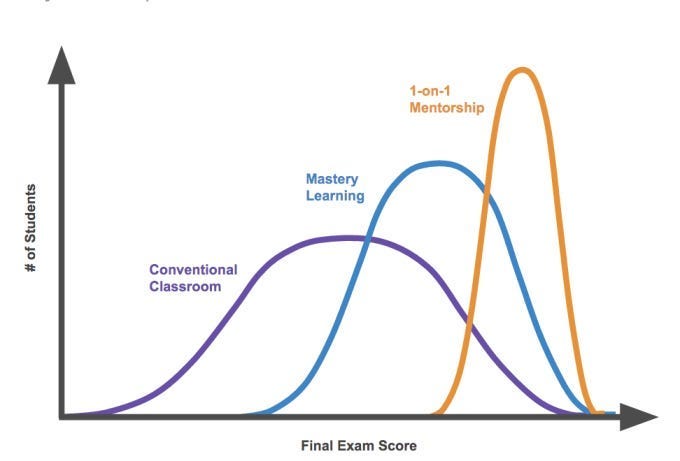
Education has lived for forty years under the shadow of Bloom’s famous 2 Sigma Problem. One-to-one tutoring, Bloom found, dramatically outperformed classroom instruction.
The implication was devastating and obvious: the most effective form of teaching was also the least scalable.
We responded by trying everything except solving the actual problem:
smaller classes
better textbooks
more technology
more assessments
But what we never cracked was the core constraint: human expertise does not scale well.
Great teachers are complex, tacit, and context-bound. Their skill accumulates slowly, spreads imperfectly, and burns out easily. Pedagogical excellence does not compound the way software does.
AI tutoring systems, by contrast, do something historically unprecedented:
improvements propagate instantly
insights from one learner benefit millions
feedback loops are continuous
refinement is exponential
For the first time, Bloom’s problem is no longer constrained by human scarcity.
The Central Paradox: AI That Teaches vs AI That Harms Learning
Here is the paradox that sits at the heart of AI tutoring:
The same underlying technology can dramatically improve learning — or actively destroy it.
This is not theoretical. It is already happening.
On one side, carefully designed AI tutors:
scaffold thinking instead of replacing it
increase cognitive effort at the right moments
resist answering when struggle is pedagogically necessary
optimise for long-term retention, not short-term fluency
On the other side, generic AI tools:
eliminate productive struggle
promote cognitive offloading
create the illusion of understanding
weaken independent reasoning over time
The difference is not intelligence.
It is design intent.

Most AI systems today are engineered for efficiency.
Learning, however, is inherently inefficient.
Understanding is built through friction.
The Illusion of Learning
One of the most dangerous properties of modern AI is how convincing it feels.
Fluent explanations feel like mastery.
Correct answers feel like understanding.
Speed feels like competence.
But fluency is not learning.
When AI systems remove the cognitive work from learners, they do not augment thinking — they quietly replace it. Over time, this produces a dependency that looks like productivity but functions like atrophy.
This distinction matters because students are already using AI at scale, often in ways that feel helpful but are pedagogically corrosive.
The risk is not that AI will fail.
The risk is that it will succeed at the wrong objective.
Why Most “AI Tutors” Are Pedagogically Dangerous
A genuine tutor is not maximally helpful.
A good tutor:
withholds answers
times feedback precisely
allows confusion without panic
remembers how the learner previously failed
This requires something counterintuitive: strategic unhelpfulness.
Large language models, by default, are optimised to be agreeable, fluent, and fast. These are virtues in customer support and productivity tools. They are vices in learning systems.
A real AI tutor must be deliberately constrained to work against its natural tendencies. It must prioritise learning outcomes it cannot directly observe, over user satisfaction it can.
That is not an accidental property.
It is a design philosophy.
The Knee in the Curve
Education has historically improved linearly.
AI improves exponentially.
Each tutoring interaction generates data.
That data refines the system.
Better systems attract more use.
More use accelerates improvement.
This feedback loop does not exist in human teaching at scale.
We may currently be in the flat part of the curve, where AI tutors still lag skilled human tutors in subtle ways. But the direction of travel is clear.
The real question is not whether AI will become exceptionally good at instruction.
The mechanisms that drive exponential improvement are already in place.
The real question is whether we will have the wisdom to deploy this capability in service of human understanding rather than its erosion.
What Remains Human
If instruction becomes algorithmic, what is left for humans?
Quite a lot. But it is different from what we have historically pretended teaching to be.
Education is not only about optimising memory formation.
It is about values, identity, purpose, culture, and meaning.
AI may master instruction.
Humans must still decide what learning is for.
The danger is not that AI tutors will outperform us.
The danger is that they will redefine learning itself — narrowing it to what is easiest to measure and optimise.
The Question We Cannot Avoid
So, what happens when every child has a personal AI tutor?
Learning may become more effective, more equitable, and more scalable than at any point in human history.
Or it may become shallow, dependent, and quietly hollow.
The outcome will not be determined by the models we build.
It will be determined by the design choices we make now.
We are no longer asking whether AI belongs in education.
That question has already been answered by reality.
The question is whether we are prepared to design AI tutors that respect how humans actually learn — or whether we will optimise ourselves out of understanding.
Our Vision for personal AI Tutors for everyone